Chortiza Colony
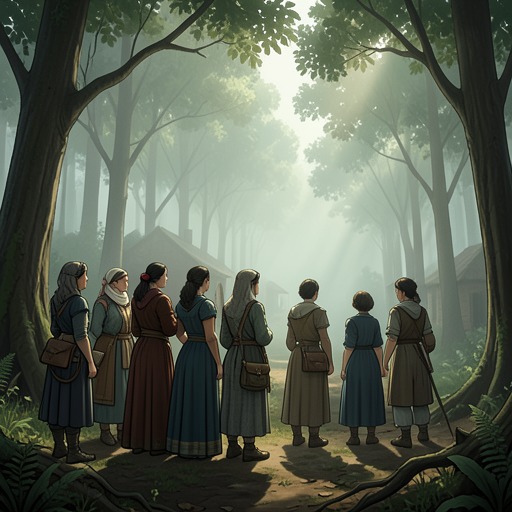
Women TalkingChortiza Colony is a neighboring settlement linked to Molotschna Colony by practical exchange, shared youth gatherings, and the routes that matter to the women’s plans. It is not simply a point on a map: people from Chortiza bring information and veterinary expertise, its church grounds are a meeting place, and the Koop brothers shelter horses needed for the departure. At the same time, the women fear that young men associated with Chortiza could warn the men in the city or interfere with their plans. The colony’s significance lies in this unresolved proximity: it offers useful connections, but cannot be treated as an uncomplicated refuge.
A Neighboring Colony and a Network of Contact
The account establishes Chortiza Colony as close enough to Molotschna for movement between the settlements to be part of ordinary life. A veterinarian from Chortiza visits Molotschna while Klaas Loewen is away. Greta Loewen tells Klaas that the veterinarian has recommended quarantining sick horses for two weeks to prevent the infection from spreading. When Klaas says that Peters has instructed him to take at least twelve horses to auction, Greta counters that sick horses will bring nothing and could earn him a fine. The visit demonstrates a concrete channel of expertise across the colony boundary, and Greta uses that advice to challenge an order made within Molotschna.
The connection is social as well as practical. Young people from both colonies spend leisure time together on Wednesday and Sunday evenings behind the Chortiza church, near a pit used for burning animal carcasses. That regular meeting place gives Autje Loewen and Neitje Friesen a connection they can call on when they need help. It also shows that the boundary between settlements does not prevent relationships from forming across it. Chortiza enters the story through these specific exchanges and encounters, rather than through a broad description of its government, population, or landscape.
Maps and the Limits of What Is Known
Chortiza is also associated with the women’s effort to imagine a route beyond their immediate surroundings. When the narrator answers that a map is available from Chortiza, the women are startled and ask how the neighboring colony came to possess one. The narrator declines to disclose that information for safety reasons, but says the map might be borrowed briefly. Autje and Neitje, whose artistic ability is valued by the group, could copy it onto packaging paper. The map is not presented as an object already in the women’s possession; the proposal is tentative, and the women’s response is generally favorable, with Mariche Loewen excepted.
Salome Friesen presses for a more useful kind of map: one of the specific region, with highways, minor roads, rivers, and rail tracks. Her request shifts the discussion from the possibility of seeing a larger world to the practical knowledge needed to travel through it. Mariche objects that they are not planning to traverse the planet, while Ona Friesen suggests that their journey might be more far-reaching than Mariche assumes. Ona’s example of butterflies and dragonflies whose migrations may take generations to reach their destination gives the discussion a scale beyond an immediate escape. Chortiza matters here as a possible source of geographic knowledge, but the evidence does not confirm that the proposed regional map exists or that the women obtain it.
A Temporary Haven for Ruth and Cheryl
The clearest material use of Chortiza comes when Autje and Neitje move Ruth and Cheryl, Greta’s beloved horses, out of Molotschna. After Klaas leaves for the city without the horses, the two young women ride them in darkness to Chortiza. There, behind the church, they meet the Koop brothers, who agree to keep the horses in their barn overnight. The next morning, once Klaas has gone, the brothers return Ruth and Cheryl to Greta’s barn in Molotschna. The horses are then safe and ready to leave with the women.
This is a carefully timed chain of cooperation, not a permanent transfer to Chortiza. The horses are taken there only for the night, and their return to Greta’s barn is part of the plan. The church-side meeting place, the Koop brothers’ barn, and the timing of Klaas’s absence all become practical parts of the operation. Neitje’s account of what she and Autje did is met by smiles and approval from most of the women, confirming how much the group depends on small acts of coordination as well as its larger decision to leave.
Aid, Suspicion, and the Planned Route
Chortiza’s connections become less reassuring when the women consider whether their preparations have been discovered. Neitje argues that the Koop boys do not have telephones, adding that they would have bragged if they did; the women trust her account. Agata Friesen nevertheless proposes a possible explanation for a warning about a fire to the north of Molotschna: the Koop boys might be waiting for the women to move, then ride to the city to inform the men or prevent the departure themselves. In her reading, the supposed fire is meant to drive the women south, toward the men, and into a trap.
This is a suspicion voiced during the women’s deliberations, not a confirmed account of what the Koop brothers intend. Ona recognizes the danger in the scenario, while Mariche argues that the women should disregard the report and head north, away from the men. The contrast matters: the same neighboring colony whose residents help safeguard Ruth and Cheryl is also linked, in the women’s fears, to the possibility of betrayal or obstruction. The account leaves that tension intact. Chortiza Colony is neither established as an enemy settlement nor simply absorbed into the women’s escape plan; it remains a nearby community whose people and resources may assist, complicate, or endanger their movement.